What are the projected dates for the probes contact with Bennu? The return to Earth?
 Artist's rendering of the OSIRIS-Male monarch spacecraft | |||||||||||||||
| Names | Origins, Spectral Interpretation, Resource Identification, Security, Regolith Explorer; New Frontiers iii | ||||||||||||||
|---|---|---|---|---|---|---|---|---|---|---|---|---|---|---|---|
| Mission type | Asteroid sample return[1] | ||||||||||||||
| Operator | NASA / Lockheed Martin | ||||||||||||||
| COSPAR ID | 2016-055A | ||||||||||||||
| SATCAT no. | 41757 | ||||||||||||||
| Website | asteroidmission.org | ||||||||||||||
| Mission duration | seven years (planned) 505 days at asteroid five years, 7 months, i day (elapsed) 1224 days at asteroid | ||||||||||||||
| Spacecraft properties | |||||||||||||||
| Manufacturer | Lockheed Martin | ||||||||||||||
| Launch mass | 2,110 kg (iv,650 lb)[2] | ||||||||||||||
| Dry out mass | 880 kg (ane,940 lb) | ||||||||||||||
| Dimensions | 2.44 × 2.44 × 3.xv chiliad (viii ft 0 in × eight ft 0 in × 10 ft iv in) | ||||||||||||||
| Power | 1226 to 3000 watts | ||||||||||||||
| Start of mission | |||||||||||||||
| Launch appointment | 8 September 2016, 23:05 UTC[3] | ||||||||||||||
| Rocket | Atlas 5 411 (AV-067) | ||||||||||||||
| Launch site | Greatcoat Canaveral, SLC-41 | ||||||||||||||
| Contractor | United Launch Alliance (ULA) | ||||||||||||||
| Terminate of mission | |||||||||||||||
| Landing appointment | 24 September 2023, xv:00 UTC (planned)[4] | ||||||||||||||
| Landing site | Utah Test and Training Range[4] | ||||||||||||||
| Orbital parameters | |||||||||||||||
| Reference system | Bennu-centric | ||||||||||||||
| Altitude | 0.68–two.one km (0.42–1.thirty mi)[5] [six] | ||||||||||||||
| Period | 22–62 hours[seven] [6] | ||||||||||||||
| Flyby of Earth | |||||||||||||||
| Closest approach | 22 September 2017[2] [8] | ||||||||||||||
| Altitude | 17,237 km (10,711 mi) | ||||||||||||||
| Bennu orbiter | |||||||||||||||
| Orbital insertion | 31 December 2018[9] (Rendezvous: three Dec 2018) | ||||||||||||||
| Orbital divergence | 10 May 2021[10] | ||||||||||||||
| Sample mass | Between threescore chiliad (2.1 oz) and 2,000 g (71 oz) | ||||||||||||||
| Bennu lander | |||||||||||||||
| Landing engagement | 20 October 2020, 22:13 (2022-04-10UTC04:55:28) UTC | ||||||||||||||
| Landing site | "Nightingale" | ||||||||||||||
| Flyby of Bennu | |||||||||||||||
| Closest arroyo | 7 April 2021[11] | ||||||||||||||
| Distance | 3.5 km (ii.2 mi) | ||||||||||||||
| |||||||||||||||
 OSIRIS-King mission logo New Frontiers plan | |||||||||||||||

OSIRIS-REx in Launch Configuration
OSIRIS-REx (Origins, Spectral Interpretation, Resource Identification, Security, Regolith Explorer) is a NASA asteroid-study and sample-render mission.[12] The mission'southward primary goal is to obtain a sample of at least 60 g (2.one oz) from 101955 Bennu, a carbonaceous near-Earth asteroid, and return the sample to Earth for a detailed assay. The material returned is expected to enable scientists to learn more virtually the formation and development of the Solar Organisation, its initial stages of planet formation, and the source of organic compounds that led to the formation of life on Globe.[13]
OSIRIS-Male monarch was launched on eight September 2016, flew past Earth on 22 September 2017, and rendezvoused with Bennu on 3 Dec 2018.[14] It spent the next several months analyzing the surface to find a suitable site from which to extract a sample. On 20 October 2020, OSIRIS-Male monarch touched down on Bennu and successfully collected a sample.[xv] [16] Though some of the sample escaped when the flap that should have closed the sampler head was jammed open up by larger rocks, NASA is confident that they were able to retain between 400 g and over 1 kg of sample material, well in excess of the 60 g (ii.i oz) minimum target mass.[17] [18] OSIRIS-REx is expected to return with its sample to Earth on 24 September 2023.[19]
Bennu was chosen as the target of written report because it is a "time capsule" from the birth of the Solar System.[twenty] Bennu has a very dark surface and is classified every bit a B-type asteroid, a sub-blazon of the carbonaceous C-type asteroids. Such asteroids are considered "archaic", having undergone trivial geological change from their fourth dimension of formation. In item, Bennu was selected because of the availability of pristine carbonaceous material, a cardinal element in organic molecules necessary for life too as representative of thing from earlier the formation of Earth. Organic molecules, such as amino acids, have previously been found in meteorite and comet samples, indicating that some ingredients necessary for life can be naturally synthesized in outer space.[ane]
The cost of the mission is approximately The states$800 meg,[21] non including the Atlas V launch vehicle, which is well-nigh US$183.5 million.[22] It is the third planetary science mission selected in the New Frontiers program, after Juno and New Horizons. The master investigator is Dante Lauretta from the University of Arizona. If successful, OSIRIS-REx will be the first United States spacecraft to return samples from an asteroid. The Japanese probe Hayabusa returned samples from 25143 Itokawa in 2010, and Hayabusa2 returned from 162173 Ryugu in Dec 2020. On 10 May 2021, OSIRIS-Rex successfully completed its departure from Bennu and began its two-year return to Earth.[23] [24]
Mission [edit]

Asteroid Bennu, imaged by the OSIRIS-REx probe, iii Dec 2018
OSIRIS-Rex mission overview video
Overall management, applied science and navigation for the mission is provided past NASA'due south Goddard Space Flying Center, while the University of Arizona's Lunar and Planetary Laboratory provides principal scientific discipline operations and Lockheed Martin Infinite Systems built the spacecraft and provides mission operations.[2] The scientific discipline team includes members from the United States, Canada, France, Frg, Great britain, and Italy.[25]
After traveling for approximately two years, the spacecraft rendezvoused with asteroid 101955 Bennu in Dec 2018,[26] and began 505 days of surface mapping at a distance of approximately 5 km (3.1 mi).[1] Results of that mapping were used past the mission team to select the site from which to take a sample of the asteroid's surface.[27] Then a shut approach (without landing) was carried out to allow extension of a robotic arm to gather the sample.[28]
Post-obit a drove of material (60 grams), the sample volition be returned to Earth in a 46 kg (101 lb) capsule similar to that which returned the samples of a comet 81P/Wild on the Stardust spacecraft. The return trip to Earth will exist shorter and the capsule will country with a parachute at the Utah Exam and Grooming Range in September 2023 earlier beingness transported to the Johnson Space Center for processing in a dedicated inquiry facility.[ane]
Launch [edit]
The launch was on 8 September 2016 at 23:05 UTC on a United Launch Alliance Atlas Five 411 from Cape Canaveral, Space Launch Circuitous 41.[3] The 411 rocket configuration consists of a RD-180 powered first phase with a single AJ-60A solid fuel booster, and a Centaur upper stage.[29] OSIRIS-Rex separated from the launch vehicle 55 minutes subsequently ignition.[two] The launch was alleged "exactly perfect" by the mission'due south principal investigator, with no anomalies worked before or during launch.[30]
Cruise [edit]
OSIRIS-REx entered the cruise phase shortly after separation from the launch vehicle, following successful solar console deployment, propulsion system initiation, and institution of a advice link with Globe.[30] Its hyperbolic escape speed from Earth was about five.41 km/southward (3.36 mi/s).[31] On 28 December 2016, the spacecraft successfully performed its first deep space maneuver to modify its velocity past 431 yard/s (1,550 km/h) using 354 kg (780 lb) of fuel.[32] [33] An additional, smaller firing of its thrusters on eighteen January 2017 further refined its course for an Earth gravity assist on 22 September 2017.[32] The cruise stage lasted until its run into with Bennu in Dec 2018,[26] after which information technology entered its science and sample collection phase.[32]
During its cruise phase, OSIRIS-REx was used to search for a form of near-Globe objects known equally Globe-Trojan asteroids as it passed through Sunday–Globe Fiftyiv Lagrange bespeak. Between 9–twenty February 2017, the OSIRIS-King team used the spacecraft's MapCam photographic camera to search for the objects, taking about 135 survey images each mean solar day for processing by scientists at the University of Arizona. The search was beneficial even though no new trojans were establish,[34] every bit it closely resembled the operation required as the spacecraft approached Bennu, searching for natural satellites and other potential hazards.[33] [35] On 12 February 2017, while 673×10 ^ half dozen km (418×10 ^ 6 mi) from Jupiter, the PolyCam instrument aboard OSIRIS-Rex successfully imaged the giant planet and three of its moons, Callisto, Io, and Ganymede.[36]
OSIRIS-Male monarch flew by Earth on 22 September 2017.[37]
Arrival and survey [edit]
On 3 December 2018, NASA affirmed that OSIRIS-REx had matched the speed and orbit of Bennu at a distance of nigh nineteen km (12 mi), finer reaching the asteroid. OSIRIS-REx performed closer passes of the Bennu surface, initially at most 6.5 km (4.0 mi) through December to further refine the shape and orbit of Bennu. Preliminary spectroscopic surveys of the asteroid'southward surface by OSIRIS-REx spacecraft, detected the presence of hydrated minerals in the form of clay. While researchers doubtable that Bennu was also small to host water, the hydroxyl groups may have come up from water presence in its parent body before Bennu split off.[38] [39]
OSIRIS-Male monarch entered orbit around Bennu on 31 December 2018 at about i.75 km (1.09 mi) to beginning its extensive remote mapping and sensing campaign for the pick of a sample site. This is the closest distance that whatsoever spacecraft has orbited a angelic object, surpassing the Rosetta 's orbit of comet 67P/Churyumov–Gerasimenko at 7 km (4.3 mi).[14] [40] At this distance, information technology takes the spacecraft 62 hours to orbit Bennu.[41] At the end of this detailed survey, the spacecraft entered a closer orbit with a radius of ane km (0.62 mi).[42]
-

Animation of OSIRIS-REx's trajectory from 9 September 2016
OSIRIS-Rex· 101955 Bennu· Globe -

Animation of OSIRIS-REx'due south trajectory around 101955 Bennu from 25 December 2018
OSIRIS-REx· 101955 Bennu -
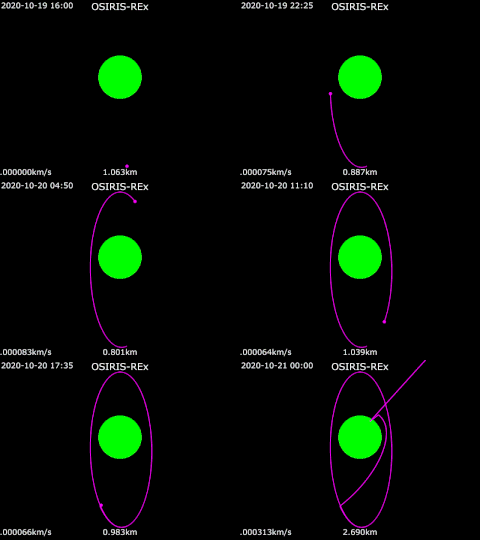
Animation of OSIRIS-REx touchdown on Bennu
OSIRIS-REx· 101955 Bennu
Sample acquisition [edit]
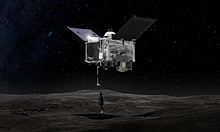
Artist's concept of TAGSAM musical instrument in operation
Procedure [edit]
Rehearsals were performed before the sampling event, during which the solar arrays were to exist raised into a Y-shaped configuration to minimize the chance of dust accumulation during contact and provide more than ground clearance in instance the spacecraft tips over (upward to 45°) during contact.[25] The descent was very tiresome to minimize thruster firings prior to contact in order to reduce the likelihood of asteroid surface contamination by unreacted hydrazine propellant. Contact with the surface of Bennu was to exist detected using accelerometers, and the impact forcefulness was meant to be dissipated by a spring in the TAGSAM arm.[43]
Upon surface contact by the TAGSAM instrument, a outburst of nitrogen gas was released, which was meant to blow regolith particles smaller than 2 cm (0.eight in) into the sampler head at the terminate of the robotic arm. A five-second timer express the collection time to mitigate the adventure of a collision. After the timer expired, the back-away maneuver executed a prophylactic departure from the asteroid.[25]
The plan was then for OSIRIS-REx to perform a braking maneuver a few days later to halt the drift away from the asteroid in instance it was necessary to return for some other sampling endeavor. It would then accept images of the TAGSAM head to verify a sample had been acquired. If a sample was caused, the spacecraft would rotate almost the brusque axis of the sample arm to decide sample mass by measuring momentum of inertia and decide if information technology was in backlog of the required sixty thousand (2.1 oz).
Both the braking and rotation maneuvers were canceled every bit images of the sample container clearly showed a big backlog of fabric was collected, a portion of which was able to escape through the container's seal due to some material jamming the mechanism open up. The collected material was scheduled for immediate storage in the Sample-Return Capsule.[44] [25] On 28 October 2020, the sample collector head was secured in the render capsule. Post-obit the severance of the caput from the collector arm, the arm will and so be retracted into its launch configuration, and the Sample-Render Capsule hat will exist closed and latched preparing to render to World.[45] [46]
In add-on to the bulk sampling mechanism, contact pads on the terminate of the sampling head fabricated of tiny stainless steel loops (Velcro)[47] passively collected dust grains smaller than 1 mm.
Operations [edit]
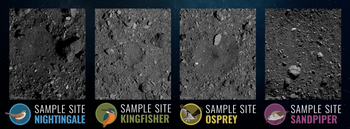
The terminal 4 candidate sample sites
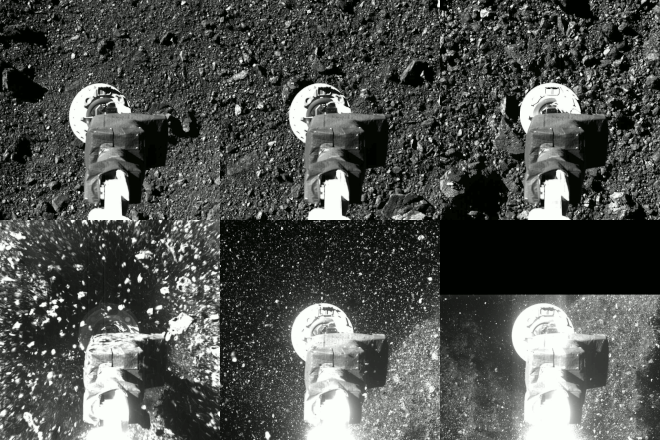
The successful Oct 2020 sample collection, showing OSIRIS-Male monarch touching downwards on the Nightingale sample site
Sample collection every bit seen by the navigation camera (00:47; Oct 20, 2020)

Images of the TAGSAM head showing that information technology is full of rocks and dust collected from Bennu and that it is leaking material into space
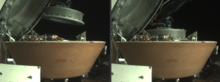
OSIRIS-REx successfully stows its sample of asteroid Bennu in October 2020.
NASA selected the final 4 candidate sample sites in August 2019, named Nightingale, Kingfisher, Osprey, and Sandpiper.[48] On 12 December 2019, they announced that Nightingale had been selected as the primary sample site and Osprey was selected as the backup site.[49] Both located inside craters, Nightingale is near Bennu's northward pole while Osprey is well-nigh the equator.[fifty]
NASA's initial plans were to perform the kickoff sampling in late August 2020;[51] NASA'southward originally planned Touch-and-Go (TAG) sample collection outcome was scheduled for 25 Baronial 2020, but was rescheduled for 20 October 2020, at 22:xiii UTC.[52] [53] On 15 Apr 2020, the first sample collection rehearsal was successfully performed at the Nightingale sample site. The practice took OSIRIS-King as close as 65 m (213 ft) from the surface before performing a back-away fire.[54] [55] A second rehearsal was successfully completed on 11 Baronial 2020, bringing OSIRIS-REx down to 40 g (130 ft) from the surface. This was the concluding rehearsal earlier the sample collection scheduled to take place on twenty October 2020, at 22:thirteen UTC.[56] [57]
At 22:thirteen UTC , on 20 October 2020, OSIRIS-REx successfully touched-down on Bennu.[58] NASA confirmed via images taken during sampling that the sampler had made contact. The spacecraft touched down within 92 cm (36 in) of the target location.[59] [60] A sample of the asteroid which was estimated to counterbalance at least 2 ounces (sixty grams) was collected by OSIRIS-King post-obit the touch downward.[xv] After imaging the TAGSAM head, NASA ended that there are rocks wedged in the mylar flap that is meant to go along the sample in, causing the sample to slowly escape into space.[61] In order to preclude further loss of the sample through the flaps, NASA canceled the previously-planned spinning maneuver to decide the mass of the sample likewise as a navigational braking maneuver and decided to stow the sample on 27 Oct 2020 rather than 2 Nov 2020 as was originally planned, which was completed successfully. Information technology was seen that the collector head hovering over the SRC afterward the TAGSAM arm moved it into the proper position for capture and later the collector head secured onto the capture ring in the Sample Return Capsule.[61]
When the head was seated into the Sample-Render Sheathing's capture ring on 28 October 2020, the spacecraft performed a "backout cheque", which commanded the TAGSAM arm to dorsum out of the capsule. This maneuver is designed to tug on the collector caput and ensure that the latches – which keep the collector head in place – are well secured. Post-obit the test, the mission team received telemetry confirming that the caput is properly secured in the Sample-Return Capsule. Thereafter, on 28 October 2020, two mechanical parts on the TAGSAM arm must first be disconnected – these are the tube that carried the nitrogen gas to the TAGSAM caput during sample collection and the TAGSAM arm itself. Over the next several hours, the mission team commanded the spacecraft to cut the tube that stirred up the sample through the TAGSAM caput during sample collection, and separate the collector caput from the TAGSAM arm. Once the squad confirmed these activities were done, information technology commanded the spacecraft on 28 October 2020, to close and seal the Sample-Return Capsule, the final step of the sample stowage process of Bennu's samples.[62] To seal the SRC, the spacecraft closes the lid and and then secures two internal latches. Additionally, on inspecting images, information technology was observed that a few particles had escaped from the collector head during the stowage process, but it was confirmed that no particles would hinder the stowage process, since the team was confident that a plentiful amount of material remains inside of the head, existence more than than the needed amount, 60 k (2.1 oz), that is, between 60 g (2.1 oz) and two,000 k (71 oz). The sample of Bennu is safely stored and fix for its journey to Earth. At present that the collector caput is secure inside the SRC, pieces of the sample will no longer be lost.[63]
Sample return [edit]
The OSIRIS-REx squad is now preparing the spacecraft for the next phase of the mission, the return prowl to World.[64] [65] On 7 Apr 2021, OSIRIS-REx completed its final flyover of Bennu and began slowly drifting away from the asteroid.[66] On 10 May 2021, OSIRIS-REx officially left the Bennu asteroid and began its two year journeying to Earth with the asteroid sample.[67]
On 24 September 2023, the OSIRIS-REx return sheathing is scheduled to re-enter World's atmosphere and country nether a parachute at the Air Force's Utah Exam and Preparation Range.[68] The sample would exist curated at NASA's Astromaterials Enquiry and Exploration Science Advisers (ARES) and at Nihon'due south Extraterrestrial Sample Curation Center.[68] [69] The sample material from the asteroid would be distributed to requesting organisations worldwide past ARES.[24]
Extended mission [edit]
An extended mission is under consideration to rendezvous with near-Earth asteroid Apophis in April 2029, but after its close arroyo with Globe. The mission contour would be like to that carried out at Bennu, with a slow approach phase and rendezvous earlier entering orbit almost the asteroid.[70]
Proper noun [edit]
OSIRIS-Rex is an acronym, and each letter of the alphabet or combination of messages relates to office of the projection:[71]
- O – origins
- SI – spectral interpretation
- RI – resource identification
- Due south – security
- King – regolith explorer
Each of these words was chosen to represent an aspect of this mission.[71] For case, the S, for security means the security of Earth from hazardous NEO.[71] Specifically it refers to amend understanding the Yarkovsky upshot, that changes the trajectory of the asteroid.[71] Regolith Explorer means that the mission will study the texture, morphology, geochemistry, and spectral properties of the regolith of asteroid Bennu.[71]
When its heritage concept was proposed in the Discovery Programme in 2004, it was called merely OSIRIS, with REx for "Regolith Explorer" used descriptively rather than equally role of the proper name.[72] This mission is too sometimes called New Frontiers three, for it existence the third of the New Frontiers programme missions.[72] [73]
The acronym OSIRIS was chosen in reference to the aboriginal mythological Egyptian god Osiris, the underworld lord of the dead. He was classically depicted as a green-skinned homo with a pharaoh's beard, partially mummy-wrapped at the legs and wearing a distinctive crown with two big ostrich feathers at either side.His name was chosen for this mission [ commendation needed ] equally asteroid Bennu is a threatening Globe impactor, with an estimated 1-in-1800 chance of hit Globe in the twelvemonth 2170. Rex ways "king" in Latin.[74] [75]
Science objectives [edit]
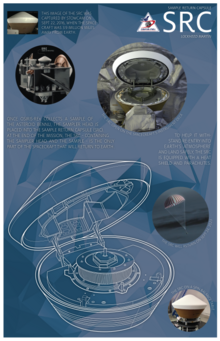
Sample Render Capsule Exploded View
The scientific discipline objectives of the mission are:[76]
- Return and analyze a sample of pristine carbonaceous asteroid regolith in an amount sufficient to written report the nature, history, and distribution of its elective minerals and organic compounds
- Map the global properties, chemical science, and mineralogy of a primitive carbonaceous asteroid to characterize its geologic and dynamic history and provide context for the returned samples
- Document the texture, morphology, geochemistry, and spectral properties of the regolith at the sampling site in situ at scales down to millimeters
- Measure the Yarkovsky effect (a thermal strength on the object) on a potentially hazardous asteroid and constrain the asteroid backdrop that contribute to this effect
- Narrate the integrated global properties of a primitive carbonaceous asteroid to permit for direct comparing with ground-based telescopic information of the entire asteroid population
Scope observations have helped define the orbit of 101955 Bennu, a near-Earth object (NEO) with a hateful diameter in the range of 480 to 511 g (1,575 to i,677 ft).[77] It completes an orbit of the Sun every 436.604 days (1.2 years). This orbit takes it close to the Earth every six years. Although the orbit is reasonably well known, scientists keep to refine it. It is critical to know the orbit of Bennu considering recent calculations produced a cumulative probability of 1 in 1410 (or 0.071%) of impact with Earth in the menses 2169 to 2199.[78] One of the mission objectives is to refine understanding of non-gravitational effects (such equally the Yarkovsky effect) on this orbit, and the implications of those effects for Bennu's collision probability. Knowing Bennu's physical backdrop will be critical for future scientists to understand when developing an asteroid impact abstention mission.[79]
Specifications [edit]
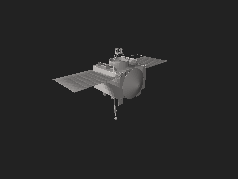
3D model of OSIRIS-REx

OSIRIS-REx instrument deck
- Dimensions: Length 2.4 m (vii ft x in), width 2.4 m (7 ft 10 in), height iii.15 g (10.3 ft)[2]
- Width with solar arrays deployed: 6.17 m (20.two ft)[2]
- Ability: Two solar arrays generate 1226 to 3000 Watts, depending on the spacecraft's distance from the Sun. Energy is stored in Li-ion batteries.[2]
- Propulsion system: Based on a hydrazine monopropellant system developed for the Mars Reconnaissance Orbiter, carrying 1,230 kg (2,710 lb) of propellant and helium.[80]
- The sample-render sheathing volition reenter the Earth's atmosphere for a parachute assisted landing. The sheathing with encased samples will be retrieved from Earth's surface and studied, as was washed with the Stardust mission.
Instruments [edit]
In addition to its telecommunication equipment, the spacecraft carries a suite of instruments to prototype and analyze the asteroid on many wavelengths,[81] and retrieve a physical sample to render to Earth. The Planetary Society coordinated a campaign to invite interested persons to take their names or artwork on the mission'due south spirit of exploration saved on a microchip at present carried in the spacecraft.[82]
OCAMS [edit]

The OSIRIS-REx Photographic camera Suite (OCAMS) consists of the PolyCam, the MapCam, and the SamCam.[81] Together, they larn data on asteroid Bennu by providing global mapping, sample site reconnaissance and label, high-resolution imaging, and records of the sample conquering.[83]
- PolyCam, an 20 cm (7.9 in) telescope, acquired visible-light images with increasingly higher resolution on approach the asteroid and high-resolution surface images from orbit
- MapCam searches for satellites and outgassing plumes. It maps the asteroid in 4 blue, greenish, ruby-red and near infrared channels, and informs the model of Bennu'due south shape and provides high resolution imaging of the potential sample sites
- SamCam continuously documents the sample acquisitions
OVIRS [edit]
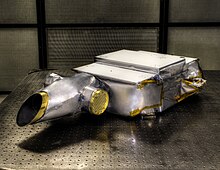
The OSIRIS-King Visible and IR Spectrometer (OVIRS) is a spectrometer which maps minerals and organic substances on the asteroid's surface.[81] It provides full-disc asteroid spectral data at 20 m resolution. It maps blueish to well-nigh-infrared, 400–4300 nm, with a spectral resolution of 7.5–22 nm.[84] This information will be used in concert with OTES spectra to guide sample-site option. The spectral ranges and resolving powers are sufficient to provide surface maps of carbonates, silicates, sulfates, oxides, adsorbed water and a wide range of organic compounds.[ citation needed ]
OTES [edit]

The OSIRIS-King Thermal Emission Spectrometer (OTES) provides thermal emission spectral maps and local spectral information of candidate sample sites in the thermal infrared channel covering 4–l µm, again to map mineral and organic substances.[81] The wavelength range, spectral resolution, and radiometric performance are sufficient to resolve and identify silicates, carbonates, sulfates, phosphates, oxides, and hydroxide minerals. OTES is also used to measure the total thermal emission from Bennu in back up of the requirement to measure emitted radiation globally.[ citation needed ]
Based on the functioning of Mini-TES in the dusty surface environs of Mars, OTES was designed to exist resilient to extreme grit contamination on the optical elements.[ citation needed ]
REXIS [edit]
The Regolith Ten-ray Imaging Spectrometer (REXIS) will provide an X-ray spectroscopy map of Bennu to map element abundances.[81] REXIS is a collaborative development by 4 groups within Massachusetts Institute of Technology (MIT) and Harvard University, with the potential to involve more than 100 students throughout the process. REXIS is based on flight heritage hardware, thereby minimizing elements of technical risk, schedule take chances, and cost risk.[ citation needed ]
REXIS is a coded discontinuity soft X-ray (0.iii–7.five keV) telescope that images 10-ray fluorescence line emission produced by the absorption of solar Ten-rays and the solar current of air with elements in the regolith of Bennu leading to local X-ray emissions. Images are formed with 21 arcminute resolution (4.iii k spatial resolution at a distance of 700 thousand). Imaging is achieved by correlating the detected X-ray paradigm with a 64×64 element random mask (1.536 mm pixels). REXIS will store each X-ray outcome data in order to maximize the data storage usage and to minimize the hazard. The pixels volition exist addressed in 64×64 bins and the 0.3–7.5 keV range volition be covered past v broad bands and eleven narrow line bands. A 24 second resolution time tag will exist interleaved with the event information to business relationship for Bennu rotation. Images will be reconstructed on the ground after downlink of the outcome listing. Images are formed simultaneously in sixteen energy bands centered on the dominant lines of abundant surface elements from O-K (0.5 keV) to Fe-Kß (7 keV) as well the representative continuum. During orbital stage 5B, a 21 day orbit 700 m from the surface of Bennu, a full of at least 133 events/asteroid pixel/energy band are expected under 2 keV; enough to obtain significant constraints on element abundances at scales larger than 10 m.[ citation needed ]
On 11 November 2019, university students and researchers involved in the mission accidentally discovered X-ray burst from a black hole name MAXI J0637-430 locate 30,000 low-cal-years abroad, during observing the asteroid with REXIS.[85]
OLA [edit]
The OSIRIS-REx Light amplification by stimulated emission of radiation Altimeter (OLA) is a scanning and lidar instrument that will provide high resolution topographical data throughout the mission.[81] The information received by OLA creates global topographic maps of Bennu, local maps of candidate sample sites, ranging in support of other instruments, and support navigation and gravity analyses.[ commendation needed ]
OLA scans the surface of Bennu at specific intervals to rapidly map the unabridged surface of the asteroid to achieve its primary objective of producing local and global topographic maps. The data nerveless by OLA will also be used to develop a control network relative to the center of mass of the asteroid and to heighten and refine gravitational studies of Bennu.[ citation needed ]
OLA has a unmarried common receiver and ii complementary transmitter assemblies that enhance the resolution of the information brought dorsum. OLA'south high-free energy laser transmitter is used for ranging and mapping from ane to 7.v km (0.62 to iv.66 mi). The depression-energy transmitter is used for ranging and imaging from 0.5 to i km (0.31 to 0.62 mi). The repetition rate of these transmitters sets the information acquisition rate of OLA. Laser pulses from both the depression and high energy transmitters are directed onto a movable scanning mirror, which is co-aligned with the field of view of the receiver telescope limiting the effects of background solar radiations. Each pulse provides target range, azimuth, top, received intensity and a time-tag.[ commendation needed ]
OLA was funded by the Canadian Infinite Agency (CSA) and was built by MDA at Brampton, Ontario, Canada.[86] OLA was delivered for integration with the spacecraft on 17 November 2015.[87] The lead instrument scientist of OLA is Michael Daly from York University.[88]
TAGSAM [edit]
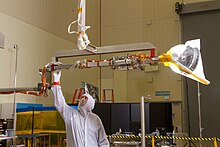
TAGSAM arm test before launch
The sample-return system, called Touch-And-Go Sample Acquisition Mechanism (TAGSAM), consists of a sampler caput with an articulated 3.35 m (11.0 ft) arm.[2] [81] An on-board nitrogen source will support upwardly to three separate sampling attempts for a minimum total amount of threescore yard (ii.1 oz) of sample. The surface contact pads volition too collect fine-grained material.[ citation needed ]
Highlights of the TAGSAM musical instrument and technique include:
- Relative approach velocity of 10 cm/s (3.9 in/s)[89]
- Contact within 25 m (82 ft) of selected location
- OCAMS documents sampling at 1 Hz
- Collect samples in less than 5 seconds, direct nitrogen (N2) annular jet fluidizes regolith, surface-contact pad captures surface sample
- Verify bulk sample collection via spacecraft inertia change; surface sample past imaging sampler head
- Sampler head stored in sample-return capsule and returned to Earth
Cooperation with JAXA [edit]
Hayabusa2 is a similar mission from JAXA to collect samples from near-Earth asteroid 162173 Ryugu. Information technology arrived at the asteroid in June 2018, left in November 2019 after ii successful sample collections, and returned to Earth in December 2020. The recovery capsule of Hayabusa2 re-entered Earth temper and landed in Commonwealth of australia, every bit planned, on 5 December 2020. The sample contents will be extensively analyzed, including h2o content which will provide clues on the initial formation of the asteroid. The main module of Hayabusa2 is performing a swing-by procedure to "push" information technology onward to its adjacent destination, asteroid 1998KY26. Due to the similarity and overlapping timelines of the two missions (OSIRIS-Rex is withal in the return stage), NASA and JAXA signed an agreement to collaborate on sample exchange and research.[90] [91] The ii teams visited each other, with representatives from JAXA visiting the OSIRIS-REx Science Operations Heart at the University of Arizona, and members of the OSIRIS-REx team traveling to Nippon to meet with the Hayabusa2 team.[92] [93] The teams are sharing software, data, and techniques for analysis, and will eventually exchange portions of the samples that are returned to Earth.[94] [95]
OSIRIS-Rex 2 [edit]
OSIRIS-King 2 was a 2012 mission concept to replicate the original spacecraft for a double mission, with the 2d vehicle collecting samples from the 2 moons of Mars, Phobos and Deimos. It was stated that this mission would be both the quickest and to the lowest degree expensive way to become samples from the moons.[96] [97]
Gallery [edit]
Narrated tour of Bennu's most prominent surface features, as seen past OSIRIS-REx

Earth–Moon organisation during an engineering test (January 2018)

Start images of asteroid Bennu (August 2018).

Asteroid Bennu from 330 km (210 mi) away (29 October 2018)

Earth-Moon (lower left) and asteroid Bennu (upper right) (December 2018)[98]
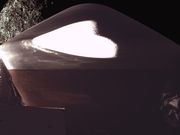
The Sample Return Capsule (SRC) with asteroid Bennu in the groundwork (December 2019)
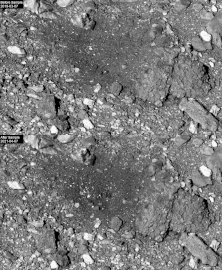
The "Nightingale" sample site pictured before and after the sampling maneuver.
Run into also [edit]
- Asteroidal water – Water and its precursors in asteroids
- Listing of asteroids visited past spacecraft
References [edit]
- ^ a b c d Brown, Dwayne C. (25 May 2011). "NASA to launch new scientific discipline mission to asteroid in 2016". NASA. Retrieved 18 September 2016.
 This article incorporates text from this source, which is in the public domain .
 - ^ a b c d e f g h "OSIRIS-King: Asteroid Sample Return Mission" (PDF) (Printing Kit). NASA. August 2016. Retrieved 18 September 2016. This article incorporates text from this source, which is in the public domain .
- ^ a b Graham, William (8 September 2016). "Atlas V begins OSIRIS-Rex's circular trip to the asteroid Bennu". NASASpaceFlight.com. NASA. Retrieved xviii September 2016.
- ^ a b Ray, Justin (ix September 2016). "OSIRIS-REx probe launched to asteroid in compelling search for the origins of life". Astronomy Now . Retrieved 18 September 2016.
- ^ "NASA's OSIRIS-REx mission breaks some other orbit record". asteroidmission.org. NASA. thirteen June 2019. Retrieved nineteen July 2020. This article incorporates text from this source, which is in the public domain .
- ^ a b "Mission Update". asteroidmission.org. NASA. 25 February 2019. Retrieved 19 July 2020. This article incorporates text from this source, which is in the public domain .
- ^ "Mission Update". asteroidmission.org. NASA. 12 Baronial 2019. Retrieved 19 July 2020. This article incorporates text from this source, which is in the public domain .
- ^ "NASA'Due south OSIRIS-REx spacecraft slingshots past Globe". nasa.gov. NASA. 22 September 2017. Retrieved 26 April 2018. This article incorporates text from this source, which is in the public domain .
- ^ "NASA'Southward OSIRIS-Rex spacecraft arrives at asteroid Bennu". asteroidmission.org. NASA. three December 2018. Retrieved half dozen Dec 2018. This article incorporates text from this source, which is in the public domain .
- ^ "NASA's OSIRIS-Male monarch mission plans for May asteroid departure". nasa.gov. NASA. 27 January 2021. This article incorporates text from this source, which is in the public domain .
- ^ "NASA's OSIRIS-REx to fly a good day bout of Bennu". nasa.gov. 8 February 2021. Retrieved 1 April 2021.
- ^ Brown, Dwayne; Neal-Jones, Nancy (31 March 2015). "NASA'southward OSIRIS-Rex mission passes critical milestone" (Printing release). NASA. Release xv-056. Retrieved four April 2015. This article incorporates text from this source, which is in the public domain . Chang, Kenneth (5 September 2016). "NASA aims at an asteroid holding clues to the Solar arrangement's roots". The New York Times . Retrieved 6 September 2016.
Corum, Jonathan (viii September 2016). "NASA launches the Osiris-Rex spacecraft to asteroid Bennu". The New York Times . Retrieved 9 September 2016.
Chang, Kenneth (8 September 2016). "The Osiris-Rex spacecraft begins chasing an asteroid". The New York Times . Retrieved 9 September 2016. - ^ "OSIRIS-Rex mission selected for concept development" (Press release). NASA. Archived from the original on 6 June 2012. This article incorporates text from this source, which is in the public domain .
- ^ a b Chang, Kenneth (3 December 2018). "NASA's Osiris-Male monarch Arrives at Asteroid Bennu Afterwards a Ii-Year Journey". The New York Times . Retrieved 3 Dec 2018.
- ^ a b "NASA's OSIRIS-REx spacecraft collects pregnant corporeality of asteroid". NASA. 23 Oct 2020. Retrieved 26 Apr 2021.
- ^ Chang, Kenneth (20 October 2020). "Seeking Solar system's secrets, NASA's OSIRIS-Male monarch mission touches Bennu asteroid". The New York Times . Retrieved 21 October 2020.
The spacecraft attempted to suck up rocks and dirt from the asteroid, which could assist humanity'southward power to divert 1 that might slam into Earth.
- ^ Greshko, Michael (29 October 2020). "NASA's OSIRIS-Rex secures asteroid sample after surprise leak". National Geographic. Retrieved 3 November 2020.
The spacecraft grabbed and then much of the asteroid Bennu, its sample-collection device got jammed. Now the material is condom and sound.
- ^ Wall, Mike (31 October 2020). "NASA's OSIRIS-REx probe successfully stows space-rock sample". Scientific American . Retrieved 3 November 2020.
The spacecraft will deliver the pristine material from asteroid Bennu dorsum to Globe in 2023.
- ^ OSIRIS-Rex factsheet (PDF). Explorers and Heliophysics Projects Sectionalisation. ehpd.gsfc.nasa.gov (Written report). Goddard SFC: NASA. August 2011. This article incorporates text from this source, which is in the public domain .
- ^ Wall, Mike (eight September 2016). "Next stop, Bennu! NASA launches bold asteroid-sampling mission". Infinite.com.
- ^ "NASA aims to grab asteroid dust in 2020". Science Magazine. 26 May 2011. Archived from the original on 29 May 2011. Retrieved 26 May 2011.
- ^ Buck, Joshua; Diller, George (v Baronial 2013). "NASA selects launch services contract for OSIRIS-REx mission" (Printing release). NASA. Retrieved eight September 2013. This article incorporates text from this source, which is in the public domain .
- ^ Chang, Kenneth (10 May 2021). "Bye-Bye, Bennu: NASA Heads Dorsum to Globe With Asteroid Stash in Tow – The OSIRIS-King mission will spend two years cruising home with infinite rock samples that could unlock secrets of the early solar system". The New York Times . Retrieved 11 May 2021.
- ^ a b "OSIRIS-Male monarch". Astromaterials Research and Exploration Science Advisers. NASA. Retrieved 2 September 2018. This article incorporates text from this source, which is in the public domain .
- ^ a b c d Kramer, Herbert J. "OSIRIS-REx". Earth observation portal directory. Retrieved 20 April 2015.
- ^ a b Hille, Karl (nine January 2018). "NASA selects participating scientists for mission to asteroid Bennu" (Press release). NASA. Retrieved 2 February 2018. This article incorporates text from this source, which is in the public domain .
- ^ "NASA successfully launch OSIRIS-Male monarch asteroid mission". borntoengineer.com. 9 September 2016. Retrieved ix September 2016.
- ^ "UA gets U.s.$ane.2 1000000 to aid in asteroid mission". Tucson Citizen. 26 May 2011. Archived from the original on 11 October 2014. Retrieved 26 May 2011.
- ^ Graham, William (viii September 2016). "Atlas V begins OSIRIS-REx's round trip to the asteroid Bennu". NASASpaceFlight.com.
- ^ a b Wall, Mike. "'Exactly perfect'! NASA hails asteroid sample-return mission's launch". infinite.com. Space.com. Retrieved x September 2016.
- ^ "OSIRIS-REx mission & trajectory pattern". Spaceflight101.com. September 2016.
- ^ a b c Neal-Jones, Nancy (17 January 2017). "Successful Deep Space Maneuver for NASA's OSIRIS-Rex Spacecraft" (Printing release). NASA. Retrieved 7 March 2017. This commodity incorporates text from this source, which is in the public domain .
- ^ a b Clark, Stephen (i February 2017). "NASA's OSIRIS-Male monarch probe moonlights equally asteroid sleuth". Spaceflight Now . Retrieved nine March 2017.
- ^ "OSIRIS-Male monarch Asteroid Search Tests Instruments". asteroidmission.org (Press release). NASA. Retrieved 20 December 2018. This article incorporates text from this source, which is in the public domain .
- ^ Morton, Erin; Neal-Jones, Nancy (9 February 2017). "NASA'due south OSIRIS-Male monarch begins Earth-trojan asteroid search" (Printing release). NASA. Retrieved 9 March 2017. This article incorporates text from this source, which is in the public domain .
- ^ "NASA'due south OSIRIS-Male monarch takes closer image of Jupiter" (Press release). NASA. 15 February 2017. Retrieved ix March 2017. This article incorporates text from this source, which is in the public domain .
- ^ Hille, Karl (22 September 2017). "NASA'Due south OSIRIS-King spacecraft slingshots by Earth" (Press release). NASA. Retrieved 22 October 2020. This article incorporates text from this source, which is in the public domain .
- ^ "NASA's newly arrived OSIRIS-REx spacecraft already discovers water on asteroid" (Press release). NASA. 11 December 2018. This article incorporates text from this source, which is in the public domain .
- ^ "Water found on asteroid, confirming Bennu as excellent mission target". Science Daily. x December 2018. Retrieved 10 December 2018.
- ^ Morten, Eric (31 December 2018). "NASA's OSIRIS-REx spacecraft enters close orbit around Bennu, breaking record" (Press release). NASA. Retrieved 1 Jan 2019. This article incorporates text from this source, which is in the public domain .
- ^ Shekhtman, Lonnie (31 December 2018). "NASA'south OSIRIS-King spacecraft enters close orbit around Bennu, breaking record". OSIRIS-Rex mission (Press release). This article incorporates text from this source, which is in the public domain .
- ^ "Orbital B stage". asteroidmission.org (Press release). Osiris-King. Retrieved 22 March 2018. This article incorporates text from this source, which is in the public domain .
- ^ OrbitalHub. "OrbitalHub". Retrieved 22 October 2020.
- ^ Hautaluoma, Grayness; Johnson, Alana; Neal Jones, Nancy; Morton, Erin. "NASA's OSIRIS-Rex spacecraft collects significant amount of asteroid". nasa.gov (Press release). NASA. Retrieved 24 October 2020. This article incorporates text from this source, which is in the public domain .
- ^ "Sample-return capsule". Spaceflight101.com . Retrieved 25 October 2017.
- ^ Hille, Karl. "OSIRIS-Rex in the midst of sample stowage". nasa.gov (Press release). This article incorporates text from this source, which is in the public domain .
- ^ Lauretta, Dante (five February 2014). "How do nosotros know when we have collected a sample of Bennu?". dslauretta.com. Archived from the original on 21 October 2016. Retrieved 23 Baronial 2016.
- ^ "NASA Mission Selects Final Four Site Candidates for Asteroid Sample Return" (Printing release). NASA. 12 September 2019. Retrieved 28 December 2019. This article incorporates text from this source, which is in the public domain .
- ^ "10 Marks the Spot: Sample Site Nightingale Targeted for Touchdown". AsteroidMission (Press release). NASA. 12 Dec 2019. Retrieved 28 December 2019. This article incorporates text from this source, which is in the public domain .
- ^ "Twelve features on asteroid Bennu get official names". Spaceflight Insider. 24 March 2020. Retrieved 22 October 2020.
- ^ Gough, Evan (9 March 2020). "OSIRIS-REx did its Closest Flyover Yet, just 250 Meters Above its Sample Site". Universe Today. Retrieved ten March 2020.
- ^ Enos, Brittany (21 May 2020). "NASA's OSIRIS-Male monarch ready for touchdown on asteroid Bennu". NASA. Goddard Space Flying Center. Retrieved 21 May 2020. This article incorporates text from this source, which is in the public domain .
- ^ "Scout: OSIRIS-REx Sample Collection Activities - OSIRIS-REx Mission". asteroidmission.org. NASA. Retrieved 16 October 2020. This article incorporates text from this source, which is in the public domain .
- ^ Morton, Erin (16 Apr 2020). "Ane step closer to touching asteroid Bennu". phys.org . Retrieved sixteen April 2020.
- ^ "OSIRIS-REx Buzzes Sample Site Nightingale". asteroidmission.org (Printing release). NASA. fourteen Apr 2020. Retrieved xvi April 2020. This article incorporates text from this source, which is in the public domain .
- ^ "OSIRIS-REx cruises over site Nightingale during last dress rehearsal". asteroidmission.org (Press release). NASA. Retrieved 13 August 2020. This article incorporates text from this source, which is in the public domain .
- ^ "Watch: OSIRIS-Male monarch sample collection activities - OSIRIS-REx mission". asteroidmission.org (Printing release). NASA. Retrieved 16 October 2020. This article incorporates text from this source, which is in the public domain .
- ^ Potter, Sean (20 October 2020). "NASA's OSIRIS-REx spacecraft successfully touches asteroid" (Press release). NASA. Retrieved 21 October 2020. This commodity incorporates text from this source, which is in the public domain .
- ^ "OSIRIS-Male monarch TAGS Asteroid Bennu". asteroidmission.org (Press release). NASA. 21 Oct 2020. Retrieved 24 Oct 2020. This article incorporates text from this source, which is in the public domain .
- ^ "Touching the Asteroid" (video, 54:03 minutes), Nova on PBS 21 October 2020 Retrieved on 22 October 2020
- ^ a b "NASA's OSIRIS-REx Spacecraft Collects Significant Amount of Asteroid". nasa.gov (Press release). NASA. 23 October 2020. Retrieved 24 October 2020. This article incorporates text from this source, which is in the public domain .
- ^ "NASA'southward OSIRIS-Rex spacecraft is stowing samples". asteroidmission.org (Printing release). NASA. 27 October 2020. Retrieved 28 Oct 2020. This article incorporates text from this source, which is in the public domain .
- ^ "NASA'due south OSIRIS-Male monarch Spacecraft Samples stowing procedure completed". asteroidmission.org (Press release). NASA. 28 October 2020. Retrieved 29 October 2020. This article incorporates text from this source, which is in the public domain .
- ^ Hautaluoma, Grayness; Johnson, Alana; Jones, Nancy Neal; Morton, Erin (29 October 2020). "NASA's OSIRIS-REx successfully stows sample of asteroid Bennu" (Press release). NASA. Release xx-109. Retrieved xxx October 2020. This article incorporates text from this source, which is in the public domain .
- ^ Chang, Kenneth (29 October 2020). "NASA's asteroid mission packs away its cargo. Side by side stop: Earth". The New York Times . Retrieved 30 October 2020.
The OSIRIS-REX spacecraft stowed the rock and dust information technology nerveless from Bennu, setting itself up to return the sample to our planet.
- ^ "NASA'south OSIRIS-REx completes final tour of asteroid Bennu" (Press release). NASA. 7 April 2021. Retrieved 26 Apr 2021.
- ^ Dunn, Marcia (10 May 2021). "NASA spacecraft begins 2-year trip domicile with asteroid rubble". WJHL. Associated Press. Retrieved 10 May 2021.
- ^ a b Davis, Jason (five July 2018). "What's the benefit of sample return?". The Planetary Society. Retrieved 2 September 2018.
- ^ "OSIRIS-King Project". Astromaterial Science Research Grouping. JAXA. Archived from the original on 25 September 2018. Retrieved 2 September 2018.
- ^ January 2021, Meghan Bartels nineteen (19 January 2021). "NASA's OSIRIS-REx probe could make a 2nd end at infamous asteroid Apophis". Infinite.com . Retrieved 26 August 2021.
- ^ a b c d e "OSIRIS-REx acronym". asteroidmission.org (Press release).
- ^ a b Lauretta, Dante. "Asteroid sample-return mission OSIRIS – OSIRIS regolith explorer (Male monarch)" (PDF). European Infinite Agency. Archived from the original (PDF) on 23 November 2018. Retrieved 24 July 2020.
- ^ Perison, R.; Dworkin, J. (2016). Supply Chain (PDF) (Report). This article incorporates text from this source, which is in the public domain .
- ^ Wolchover, Natalie (27 May 2011). "NASAcronyms: How OSIRIS-Rex got its proper noun". LiveScience . Retrieved 12 May 2015. This article incorporates text from this source, which is in the public domain .
- ^ Moskowitz, Clara (27 May 2011). "Why NASA chose potentially threatening asteroid for new mission". Space.com. Retrieved 14 May 2017.
- ^ "OSIRIS-King info-sheet" (PDF). Lunar and Planetary Laboratory. University of Arizona. Archived from the original (PDF) on 17 Apr 2012.
- ^ Müller, T.M.; O'Rourke, L.; Barucci, A.One thousand.; Pál, A.; Osculation, C.; Zeidler, P.; Altieri, B.; González-García, B.M.; Küppers, Thou. (December 2012). "Physical backdrop of OSIRIS-REx target asteroid (101955) 1999 RQ36 . Derived from Herschel, VLT/ VISIR, and Spitzer observations". Astronomy & Astrophysics. 548. A36. arXiv:1210.5370. Bibcode:2012A&A...548A..36M. doi:10.1051/0004-6361/201220066. S2CID 55689658.
- ^ "Earth impact take chances summary for 101955 Bennu". Nigh World Object Program. JPL / NASA. 5 August 2010. Archived from the original on 9 February 2009. Retrieved 29 Apr 2013. This article incorporates text from this source, which is in the public domain .
- ^ "OSIRIS-REx - The Mission". asteroidmission.org (Press release). NASA. This commodity incorporates text from this source, which is in the public domain .
- ^ Lauretta, Dante (sixteen December 2014). "Integration of the OSIRIS-REx chief propellant tank". Dslauretta.com. Archived from the original on 27 April 2015. Retrieved 20 April 2015.
- ^ a b c d eastward f g "Instruments: Science Payload". University of Arizona. Retrieved 18 September 2016.
- ^ "NASA invites public to transport artwork to an asteroid". University of Arizona. 19 Feb 2016. Retrieved i Apr 2016.
"OSIRIS-Rex: Messages to Bennu!". The Planetary Society. Retrieved 10 September 2016. - ^ Lauretta, Dante (11 January 2014). "OCAMS – The Eyes of OSIRIS-King". Dslauretta.com. Archived from the original on 14 January 2017. Retrieved 10 September 2016.
- ^ Simon-Miller, A.A.; Reuter, D.C. (eighteen–22 March 2013). OSIRIS-REx OVIRS: A scalable, visible to near-IR spectrometer for planetary study (PDF). 44th Lunar and Planetary Science Conference. The Woodlands, Texas. Bibcode:2013LPI....44.1100S.
- ^ OSIRIS-Rex Observes a Blackness Hole (video). NASA Goddard. 3 March 2020. Archived from the original on 17 November 2021. Retrieved 5 March 2020 – via YouTube. This article incorporates text from this source, which is in the public domain .
- ^ "OLA, Canada's Contribution to OSIRIS-Rex". Canadian Infinite Agency. 4 March 2013. Retrieved 15 October 2014.
- ^ Jones, Nancy N. (17 July 2014). "Canada Contributes to NASA'south OSIRIS-REx Mission". NASA. This article incorporates text from this source, which is in the public domain .
Jeffery, Cassandra (17 December 2015). "Canada to invest in infinite exploration with new laser". Kelowna Now. - ^ "Canada'southward office in OSIRIS-Rex". asc-csa.gc.ca. 4 March 2013. Retrieved 2 October 2019.
- ^ Lauretta, Dante (27 November 2013). "How to become to Bennu and back". Dslauretta.com. Archived from the original on viii May 2016. Retrieved 10 September 2016.
- ^ Clark, Stephen (15 Dec 2014). "NASA, JAXA accomplish asteroid sample-sharing understanding". Spaceflight At present . Retrieved 12 February 2020.
- ^ Nakamura-Messenger, Keiko; Righter, Kevin; Snead, Christopher; McCubbin, Francis; Pace, Lisa; Zeigler, Ryan; Evans, Cindy (2017). "NASA curation preparation for Ryugu sample returned by JAXA's Hayabusa2 mission" (PDF) (Press release). NASA. Retrieved 12 February 2020. This article incorporates text from this source, which is in the public domain .
- ^ "Mission Update Apr. 22, 2019". AsteroidMission.org. NASA. 22 Apr 2019. Retrieved 12 February 2020. This article incorporates text from this source, which is in the public domain .
- ^ "Science Team Meeting 12". Instagram. OSIRIS-King. 29 March 2017. Archived from the original on 26 Dec 2021. Retrieved 12 February 2020.
This week nosotros're hosting Science Squad Meeting 12 at @uarizona. More than 100 members of @nasa'southward OSIRIS-REx team and @jaxajp's Hayabusa2 squad are gathered in Tucson to exchange information, share ideas and plan ways the two #asteroid-bound missions tin collaborate. #scientific discipline
- ^ Hoekenga, Christine (22 June 2018). "Two Pieces of a Cosmic Puzzle: Hayabusa2 and OSIRIS-King". asteroidmission.org. NASA. Retrieved 12 February 2020. This article incorporates text from this source, which is in the public domain .
- ^ Lauretta, Dante (20 October 2014). "Collaboration between OSIRIS-Male monarch and Hayabusa2". The Planetary Club. Retrieved 12 February 2020.
- ^ Elifritz, T.L. (12–xiv June 2012). OSIRIS-Male monarch II to Mars - Mars sample render from Phobos and Deimos (PDF). Concepts and Approaches for Mars Exploration. Houston, Texas. Bibcode:2012LPICo1679.4017E.
- ^ Templeton, Graham (31 May 2016). "OSIRIS-REx is about to go collect (and return) samples from an asteroid". ExtremeTech. Retrieved 24 November 2016.
- ^ Dunn, Marcia (8 January 2019). "Asteroid-circling spacecraft grabs cool snapshot of home width2=200". AP News. Retrieved 8 Jan 2019.
External links [edit]
 | Wikimedia Commons has media related to OSIRIS-Male monarch. |
- "OSIRIS-Rex". 20 February 2015. mission website at NASA
- "OSIRIS-Male monarch". mission website at the University of Arizona
- "OSIRIS-Male monarch Mission Annal". NASA Planetary Information Arrangement, Pocket-size Bodies Node. Academy of Maryland, Department of Astronomy.
- Video (ii:53) – Asteroid Bennu Mission Overview (NASA; xi May 2021).
Source: https://en.wikipedia.org/wiki/OSIRIS-REx
0 Response to "What are the projected dates for the probes contact with Bennu? The return to Earth?"
Post a Comment